
SEMCO Process Equipment
Spiral Heat Exchanger
Technical Specifications & Features
- Counter-current flow
- Self-cleaning channels
- Compact footprint
- Handles viscous fluids
- Low fouling tendency
Compact, highly efficient heat exchanger ideal for viscous fluids, slurries, and fouling services with self-cleaning channels.
SEMCO Process Equipment
Spiral Heat Exchanger
Larger or special designs on request. Each proposal confirms the final design and delivery.
| Heat transfer area | 1 to 200 m² |
|---|---|
| Best for | Slurries, sludges, viscous and fouling fluids |
| Flow | True counter-current, single channel per fluid |
| Materials | SS316L, duplex, titanium and other alloys |
| Typical delivery | 10 to 14 weeks after drawing approval |
Three fields. An engineer replies within one working day.
Spiral heat exchanger guide: how the single-channel design resists fouling, handles slurries and viscous fluids, sizing, pressure limits, cleaning and where it beats shell and tube.
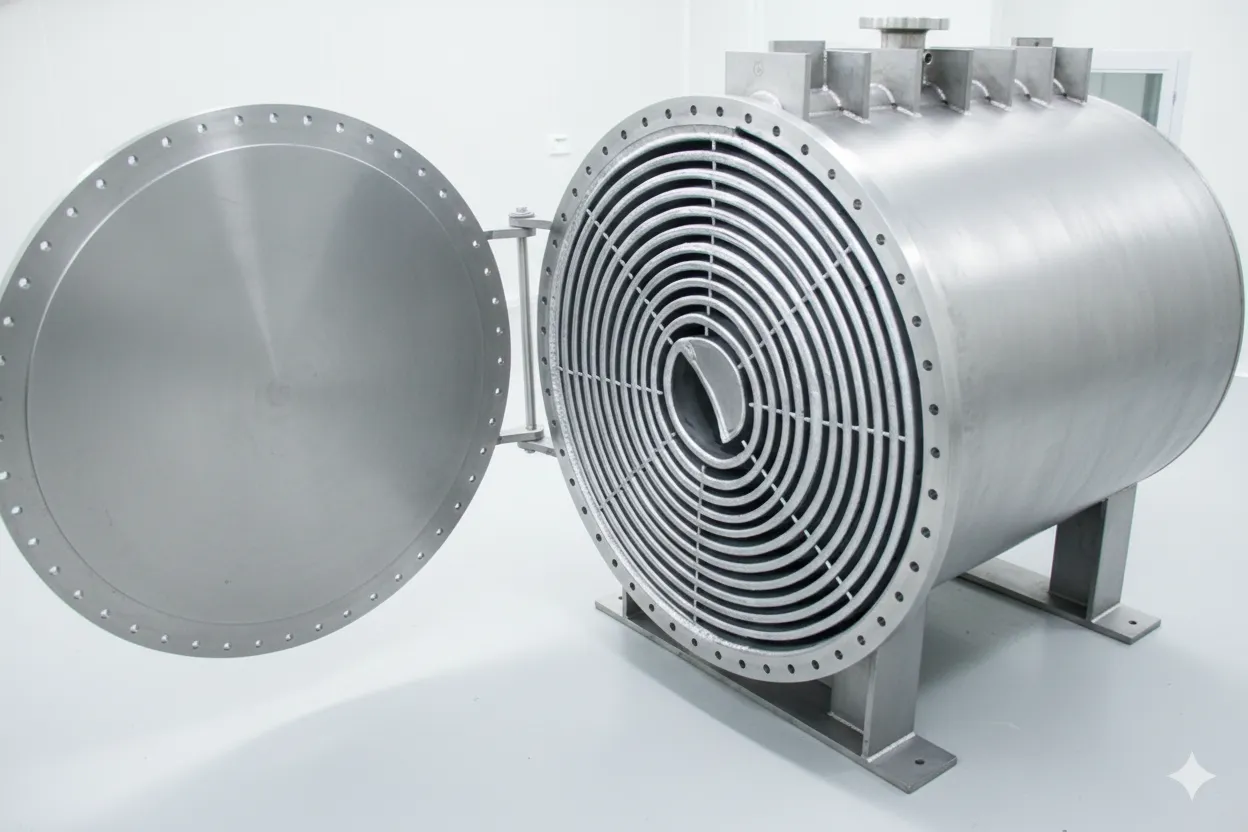
A spiral heat exchanger is made from two long metal sheets wound around a central core to form two concentric spiral channels, one for each fluid, usually in full counter-current flow. The single curved channel creates high turbulence, which makes it well suited to viscous, fouling and solids-laden fluids.
Each fluid flows through one continuous channel. If deposits start to narrow the channel, the local velocity rises and scours the deposit away. In a multi-tube exchanger the flow simply diverts to the cleaner tubes, so fouled tubes keep fouling.
A spiral heat exchanger is more compact, handles slurries and sludges, and gives a closer temperature approach through true counter-current flow. A shell-and-tube exchanger suits higher pressures and temperatures, very large duties and services where tube bundles must be replaced. Clean, low-viscosity fluids at high pressure normally favour shell-and-tube.
Typical duties are sludge heating in anaerobic digesters, heat recovery from effluent and slurries, heating and cooling of viscous polymers and resins, and condensing vapours under vacuum, where the spiral's low pressure drop helps.
The end covers open on hinges, giving direct access to the full length of each channel. The channels can then be cleaned by high-pressure water jetting, and many units are also cleaned in place with chemical circulation without opening.
Turnkey Zero Liquid Discharge (ZLD) plants that recover water for reuse and convert industrial effluent into dry, handleable solids using multi-effect evaporators, agitated thin film dryers and crystallizers.
Distillation-based solvent recovery to clean and reuse solvents from industrial processes — saving money, reducing waste, and preventing pollution. Covers methanol, acetone, IPA, ethyl acetate, and other common solvent pairs including azeotropic systems.
Chemical process technology to recover lubricating base oil from waste lubricants. Water, fuel oil, additives, and sludge are separated from the base oil under vacuum using Wiped Film Evaporation — the most cost-effective re-refining method. Base oil produced matches API Group II specifications.
The most widely used industrial heat exchanger — efficient inter-fluid heat transfer through a solid wall, across chemical plants, refineries, power plants, and HVAC systems.
Critical heat transfer equipment that supplies controlled vaporization heat to the bottom of distillation columns — generating vapor for effective mass transfer in continuous duty.
Condenses vapors or cools process fluids using ambient air — eliminating cooling water requirements with finned tube bundles and axial fans. Ideal for water-scarce locations.
SEMCO (SEMCORP Process and Vacuum Systems Pvt. Ltd.) has designed and built spiral heat exchanger systems since 2008. Process design is done at our head office in Ravet, Pimpri-Chinchwad, Pune, and fabrication in our own factories in Talawade and Indapur (Pune district) and MIDC Chincholi, Solapur. We supply plants across India and for export, with erection and commissioning by our own team.